In the paper converting and packaging industry, efficiency, precision, and material optimization are essential. Two of the most commonly used machines in this sector are the paper rewinding machine and the paper slitting machine. Although they are often used together in production lines, they serve distinct purposes and are sometimes misunderstood as interchangeable.
This article provides a comprehensive comparison of paper rewinding machine and paper slitting machine, explaining their functions, differences, applications, and selection criteria. It is also designed to help manufacturers, converters, and buyers choose the right equipment for production efficiency and cost optimization.
A paper rewinding machine is an industrial device used to rewind large rolls of paper into smaller, tightly wound rolls with improved alignment, tension control, and surface quality.
Its primary function is not to cut but to reorganize and optimize paper rolls after production or processing. The machine ensures that the final rolls are uniform, compact, and suitable for downstream applications such as printing, packaging, labeling, and converting.
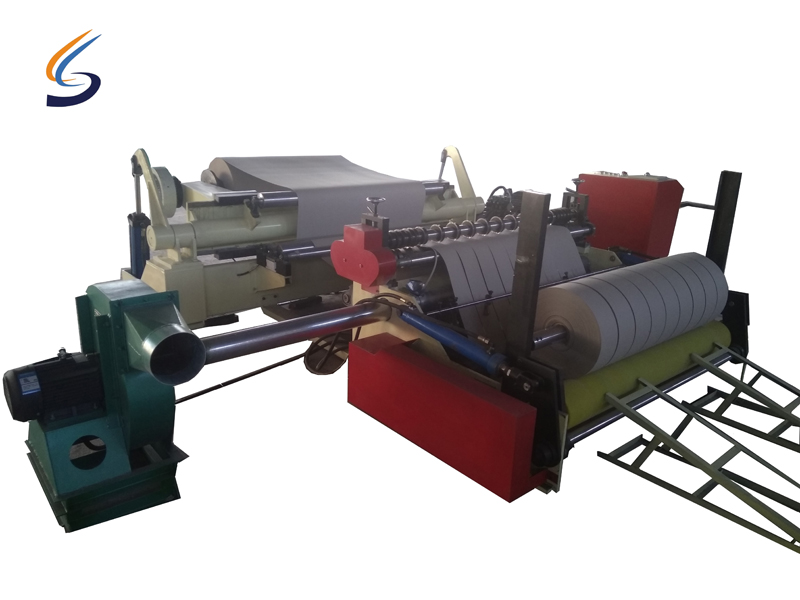
A paper slitting machine is used to cut large paper rolls into narrower widths according to specific production requirements. It uses precision blades or rotary knives to slit the material while maintaining clean edges and consistent dimensions.
Unlike rewinding machines, slitting machines focus on width customization rather than roll restructuring.
Although both machines are widely used in paper converting, their roles are fundamentally different. Understanding these differences is crucial for selecting the right equipment.
Rewinding machine: Focuses on rewinding and improving roll quality
Slitting machine: Focuses on cutting rolls into different widths
Rewinding improves roll structure and tension consistency
Slitting modifies roll dimensions and width
Rewinding outputs refined single rolls
Slitting outputs multiple narrower rolls
Rewinding machines typically do not use cutting blades
Slitting machines rely on precision blade systems (razor, rotary, or shear cutting)
Rewinding is often a finishing process
Slitting is a converting and customization process
A paper rewinding machine is the right choice when your production focus is on roll quality rather than size modification.
Your paper rolls have uneven tension or loose winding
You need to improve roll appearance and compactness
Your process involves finishing or inspection stages
You are preparing rolls for printing or coating applications
You want to eliminate defects after paper production
Rewinding machines are especially valuable in high-end packaging and printing industries where roll consistency directly affects downstream production quality.
In short, if your goal is quality refinement rather than size transformation, a rewinding machine is the correct investment.
A paper slitting machine is essential when your production requires converting large rolls into multiple smaller widths.
You need to produce multiple roll sizes from one master roll
Your products require precise width customization
You work in labeling, tape, or packaging materials production
You want to maximize material utilization efficiency
You need high-speed mass production of narrow rolls
Slitting machines are critical in industries where customization and scalability are key production requirements.
If your core need is dimension control and roll diversification, a slitting machine is the ideal solution.
The comparison of paper rewinding machine and paper slitting machine highlights that both machines serve distinct but complementary roles in the paper converting industry. Rewinding focuses on improving roll quality and tension control, while slitting focuses on dimensional customization and roll segmentation.
In modern manufacturing environments, combining both technologies into integrated systems provides the highest efficiency and flexibility.
Working with a reliable paper slitting and rewinding machine manufacturer San Machinery ensures access to advanced engineering solutions, stable production performance, and long-term operational value.
Paper slitting machines can handle various materials including kraft paper, coated paper, release paper, film, foil, and laminated materials depending on blade configuration.
Yes, in most cases. After slitting, rewinding ensures that the newly cut rolls are tight, aligned, and suitable for packaging or transport.
Regular blade inspection, tension system calibration, and roller cleaning are essential to maintain long-term precision and machine stability.
Yes. Integrated systems combine both functions to improve efficiency and reduce production space requirements.