Choosing the right paper slitting rewinding machine starts with three specifications: the maximum width of your jumbo rolls, the maximum roll diameter, and the production speed you actually need.
The machine should comfortably accommodate your largest parent roll while maintaining stable tension, accurate slitting, and consistent rewinding at normal production speed. A machine with a higher advertised speed is not automatically the better investment if your material, roll diameter, or downstream process cannot operate reliably at that speed.
Start with the maximum width of the jumbo paper rolls you normally purchase, then consider whether wider rolls may be introduced in the future.
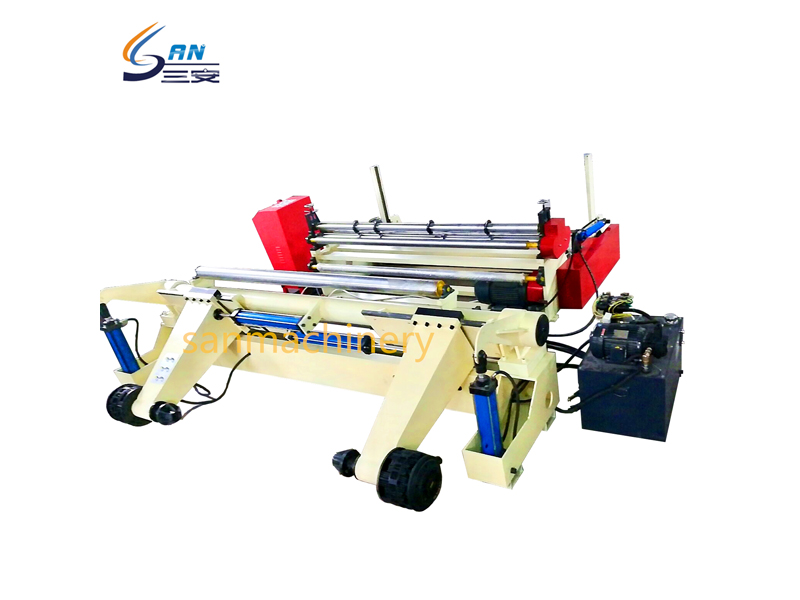
For example, SAN Machinery's SANSR-1600 and SANSE-1600 models both support jumbo rolls up to 1600 mm wide. Their standard minimum parent-roll width is 600 mm, with 400 mm available for special orders.
A buyer processing rolls from 1000 to 1500 mm wide should not select equipment based only on today's most common 1200 mm roll. Leaving reasonable width capacity for future orders can reduce the need for premature equipment replacement.
However, unnecessarily oversized equipment may increase investment without improving actual output. The best working width should therefore be based on:
current jumbo roll width;
future material sourcing plans;
required finished roll widths;
number of slit rolls per cycle;
expected production expansion.
For a paper rewinder slitter, width should always be evaluated together with the required slitting layout.
Roll diameter affects more than whether the parent roll physically fits on the machine.
A larger-diameter jumbo roll contains more paper and can support longer continuous runs, but it also increases roll weight and places greater demands on the unwinding, loading, braking, and tension-control systems.
Industry slitter-rewinder selection guides therefore treat maximum roll diameter, roll loading method, brake control, and tension control as interconnected specifications.
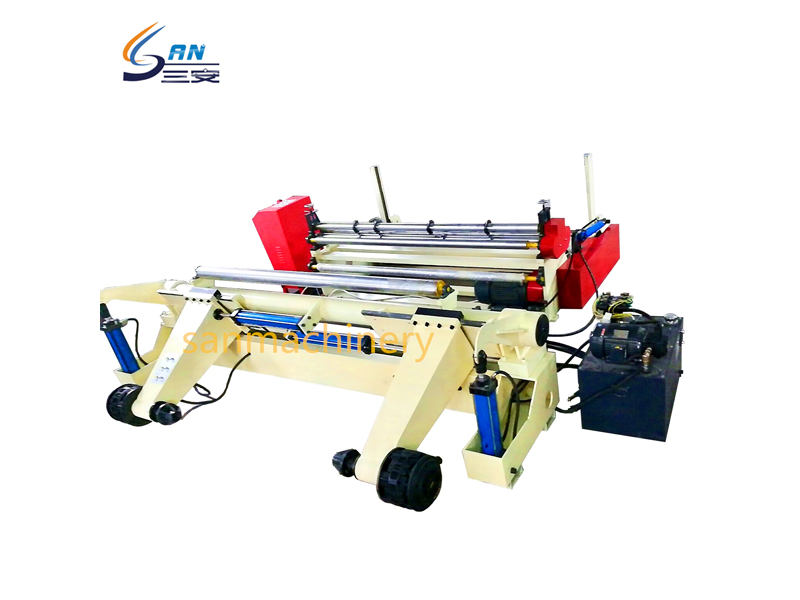
SAN Machinery's SANSR-1600 and SANSE-1600 are designed for jumbo rolls with a maximum diameter of 1300 mm. The machines also use a hydraulic shaftless paper holder to simplify loading, together with a suspension tension system designed to maintain stable web tension.
Before purchasing a machine, confirm:
Maximum unwind diameter × roll width × paper basis weight = actual roll size and loading requirement.
The machine manufacturer should evaluate the complete roll specification rather than diameter alone.
Select speed according to required output and material stability—not simply the highest number in the technical specification.
SAN Machinery offers two different speed levels for 1600 mm paper converting:
SANSR-1600: working speed of 0–250 m/min
SANSE-1600: working speed of 0–140 m/min
A higher-speed paper slitting rewinding machine is more suitable when production volume is high and reducing converting time has a meaningful effect on factory output.
A lower-speed configuration may be more economical when production volumes are moderate or when maximum throughput is not the main purchasing priority.
No. Effective productivity depends on how much saleable material the machine produces during an entire shift.
Running speed must be supported by stable unwinding, web alignment, tension control, blade performance, and rewinding quality. Poor tension control can contribute to wrinkles, inconsistent roll hardness, telescoping, and other finished-roll problems.
This is particularly important as roll diameter changes during production. Modern slitter rewinders may calculate or monitor changing roll diameter as part of tension control because unwind and rewind conditions continuously change as the rolls become smaller or larger.
For this reason, buyers should ask suppliers for the stable working speed with their actual paper, rather than comparing maximum mechanical speed alone.
These three specifications should never be evaluated independently.
Consider a factory processing 1600 mm-wide, large-diameter kraft paper rolls. If the manufacturer wants high-volume production, the machine requires more than sufficient width capacity. It also needs an unwinding structure capable of handling the roll, reliable tension control, accurate web correction, strong slitting components, and stable rewinding at the required operating speed.
SAN's SANSR-1600 combines a 1600 mm maximum jumbo-roll width and 1300 mm maximum roll diameter with speeds up to 250 m/min. The system also includes automatic web rectification, hydraulic shaftless loading, suspension tension control, and heavy-duty slitting components.
That complete configuration is more meaningful than comparing speed figures alone.
Before requesting a quotation, prepare the following specifications:
paper type and basis weight;
minimum and maximum parent-roll width;
maximum parent-roll diameter;
jumbo roll weight;
required finished roll widths;
finished roll diameter;
number of slit rolls required;
expected daily production volume;
target operating speed.
These are among the key technical details manufacturers use when configuring a slitter rewinder for a particular converting application.
Providing accurate specifications also helps avoid paying for capacity you do not need—or purchasing a machine that becomes restrictive as production grows.
The best paper slitting rewinding machine is not necessarily the widest or fastest model. It is the machine that matches your real jumbo roll dimensions, finished roll requirements, and production volume while maintaining stable slitting and rewinding quality.
Start with roll width, confirm maximum roll diameter, and then determine the stable working speed required to meet your output target.
For businesses comparing a paper rewinder slitter, SAN Machinery offers both higher-speed and economical configurations. The SANSR-1600 reaches up to 250 m/min, while the SANSE-1600 reaches up to 140 m/min, with both designed for jumbo rolls up to 1600 mm wide and 1300 mm in diameter.
It depends on the model. SAN's 1600-series machines support jumbo rolls up to 1600 mm wide and 1300 mm in diameter.
No. Stable tension, accurate slitting, and finished-roll quality are more important than maximum speed alone.
Provide paper type, roll width, roll diameter, roll weight, finished roll dimensions, required slitting widths, and target production speed.
Diameter affects roll capacity, loading requirements, unwinding behavior, and tension control throughout production.