The hexagonal pattern is the defining feature of honeycomb paperboard, but the geometry is more than a visual characteristic. Cell size, shape, wall thickness, and expansion ratio influence how the paper behaves during forming and how the finished core performs under load. For manufacturers, this means that changing cell geometry can affect much more than the appearance of the final board. It can alter material consumption, adhesive requirements, production stability, panel stiffness, and downstream processing.
Honeycomb construction achieves high stiffness with relatively low material consumption by distributing loads through a cellular structure. The geometry determines how efficiently the core supports the outer layers. A change in cell size can influence:
Core density
Compressive behavior
Panel stiffness
Material consumption
Adhesive distribution
Expansion behavior
Cutting and handling
Consequently, cell geometry should be treated as a production parameter rather than a purely design-oriented choice.
Larger cells can reduce the amount of paper used in the core because fewer cell walls are required across a given area. Smaller cells generally create a denser cellular network. However, lower paper consumption does not automatically mean lower production cost. The factory must also consider:
Adhesive consumption
Production speed
Core strength
Waste during conversion
Required surface layers
Customer performance specifications
The economically optimal cell size is therefore the one that meets the required performance at an acceptable total manufacturing cost.
Smaller cells create a greater number of cell walls within the same panel area. This can produce a denser and more closely structured core. From a manufacturing perspective, however, smaller geometry can increase the precision required during forming and adhesive application. The production line must maintain consistent:
Paper feeding
Adhesive placement
Web alignment
Expansion
Bonding
Small deviations can become more noticeable when the structure contains a large number of closely spaced cells.
Larger cells can make the core lighter and may simplify certain aspects of material consumption. But the manufacturer must verify whether the resulting structure provides sufficient support for the intended application. For protective packaging, large-cell structures may be suitable where low weight is a priority. For applications requiring greater compression resistance or surface stability, a different geometry may be preferable. The correct choice therefore depends on the balance between weight, stiffness, strength, and cost.
Honeycomb production relies on bonding paper layers at specific locations. The geometry determines the spacing and distribution of these bonding points. When cell dimensions change, the adhesive application pattern may also need to change. A production system must provide sufficient adhesive for reliable bonding without creating unnecessary adhesive consumption. This is one reason why the adhesive system and the honeycomb paper machine should be considered together when developing a new product specification.
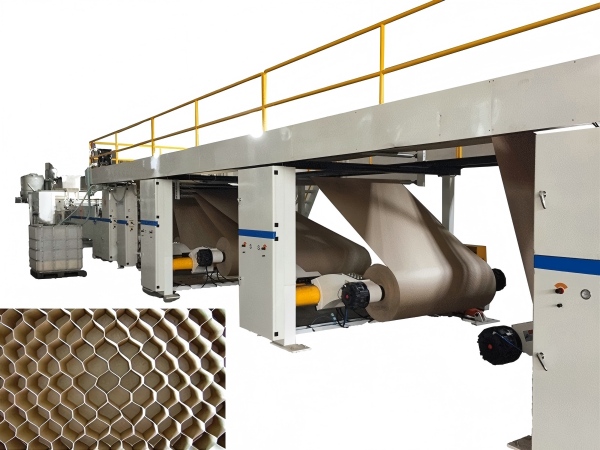
Honeycomb core is commonly formed from bonded paper material that is subsequently expanded into the desired cellular structure. Expansion changes the spacing between bonded points and determines the final cell geometry. If expansion is inconsistent, manufacturers may see:
Uneven cell sizes
Distorted panels
Irregular density
Nonuniform thickness
Inconsistent mechanical performance
Therefore, expansion should not be viewed as a simple mechanical stretching operation. It is a key step in establishing the final architecture of the core.
Honeycomb board performance depends on the interaction between the cellular core and the facing materials. Cell geometry influences how loads are distributed through the structure. The final mechanical performance also depends on paper properties, core thickness, bonding quality, and surface layers. For this reason, there is no universal “strongest” cell size. A manufacturer should define the required performance first and then evaluate which geometry provides the appropriate balance of strength and material efficiency.
Cell size should not be considered independently from core thickness. A thicker core can increase panel stiffness, while changing cell size alters the density and structure within that thickness. A useful development matrix may therefore include:
| Variable | Possible Impact |
|---|---|
| Cell size | Changes density, material consumption, and structural behavior |
| Core thickness | Influences overall panel stiffness |
| Paper basis weight | Changes wall strength and weight |
| Adhesive quantity | Affects bonding integrity and cost |
| Facing material | Influences surface strength and overall panel performance |
Testing combinations of these variables is generally more useful than optimizing one parameter in isolation.
The internal structure of honeycomb board can affect how the panel behaves during cutting. A cutting system must deal with a cellular material rather than a homogeneous sheet. Depending on the board construction, excessive cutting force or unsuitable tooling can deform the cells near the edge. For manufacturers producing specific panel sizes, the cutting stage should therefore be evaluated together with the core structure. A honeycomb cardboard cutting machine may be appropriate when the production process requires more specialized cutting or die-cutting operations.
Not effectively. Different applications prioritize different properties. Protective packaging may emphasize low weight and cushioning, while pallet or panel applications may require greater stiffness and compression resistance. Consequently, manufacturers should avoid selecting a cell size simply because it is common in the market. The better approach is to establish the application's load, handling, thickness, and cost requirements and then validate the corresponding geometry through production trials.
A practical evaluation should combine material testing and machine testing. The development process can include:
Select several candidate cell sizes.
Keep paper grade and core thickness controlled.
Evaluate forming and expansion stability.
Measure adhesive consumption and bonding quality.
Check finished panel dimensions.
Test compression and stiffness where relevant.
Compare material consumption and production efficiency.
This approach produces a more useful comparison than judging finished samples only by appearance.
An unsuitable geometry can create problems at several stages. During forming, the structure may expand inconsistently. During bonding, adhesive distribution may become difficult to control. During finishing, cutting may become less stable. In the final application, the panel may provide either insufficient strength or unnecessary material density. The important lesson is that product development and machine configuration cannot be separated.
A honeycomb core machine should be selected according to the core structure the factory actually intends to produce. If the manufacturer changes cell size after equipment has already been specified, the original configuration may no longer provide the desired production range or stability. Defining the geometry in advance gives the equipment supplier a much clearer basis for determining forming, adhesive application, expansion, and handling requirements.
No. Strength depends on several interacting factors, including paper properties, cell geometry, core thickness, bonding quality, and facing materials.
It can reduce core material consumption, but the final economic result also depends on strength requirements, adhesive consumption, waste, and production efficiency.
Expansion determines the final cell dimensions and influences density, thickness, appearance, and structural consistency.
Yes. Changes in cell geometry can change the bonding pattern and the amount of adhesive required for reliable bonding.
That depends on the machine's design and adjustment range. The required cell-size range should be specified before equipment selection.
There is no universal best size. The appropriate geometry depends on the intended application, required strength, weight target, board thickness, and manufacturing economics.